Called “reindeer” in some other parts of the world, caribou in North America are of three ecotypes based on habits adopted for the ecosystems in which they live. Barren-ground caribou range in massive herds across northern Canada’s open country. The more sedentary woodland caribou live in smaller groups within the flat-terrain boreal forests, usually for their entire lives, although with short seasonal movements. Mountain caribou inhabit the Columbia Mountains, as well as other ranges to the north, and move up and down the mountains each year in what David Moskowitz in Caribou Rainforest calls “a unique double migration.” To escape predators, he says, “mountain caribou adopted a diet of arboreal lichens that only grow in abundance in forests close to a century old or older,” which is a measure for old growth.
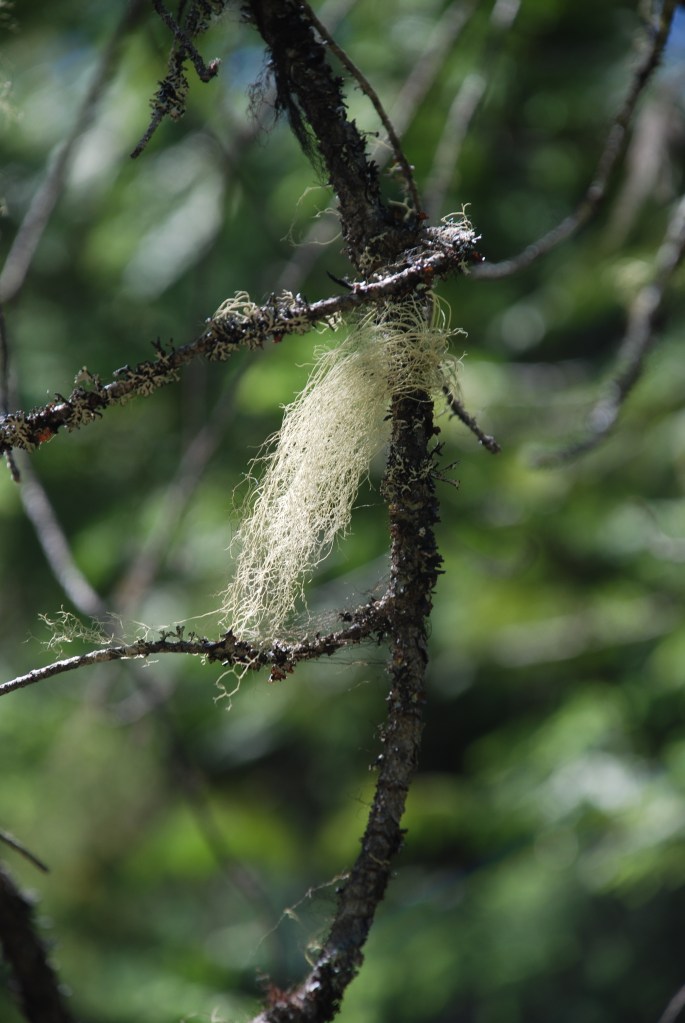
While mountain caribou eat a variety of vegetation, in winter they rely almost exclusively on lichen that grow on old-growth trees, especially black tree lichens of which there are several species, horsehair lichen seemingly the most common.
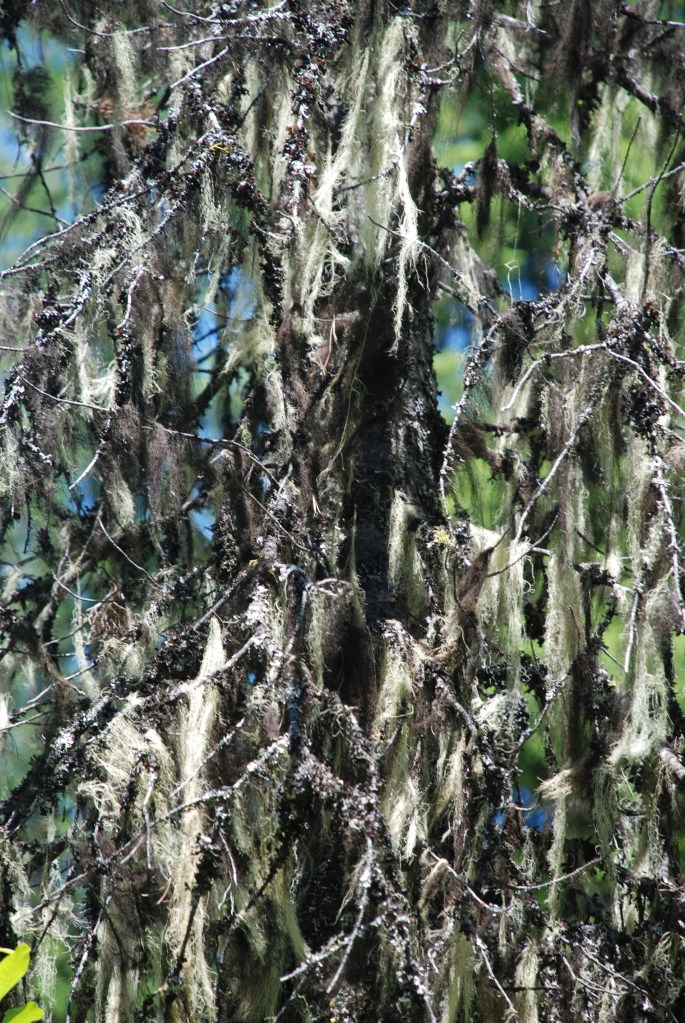
Because these lichens cannot survive when covered with snow for extended periods, they only grow on trees at a height above the winter snowpack that can be as much as ten feet in the mountains. Mountain caribou possess large hooves that allow them to negotiate the snow and reach lichens in the depths of winter, protected from the cold by their dense body hair. Separated from moose and deer that stay at lower elevations, they are mostly safe from predators (wolf, cougar, bear) that patrol the more abundant prey habitat below.
Come spring, mountain caribou begin their seasonal migrations by descending the mountains to take advantage of newly emerging plants as snow melts at lower elevations. They also feed on arboreal lichens that have fallen from trees during the winter as well as terrestrial lichens that grow on rocks and the ground. Living in groups of fewer numbers than the other ecotypes, they disperse across the landscape, which helps to avoid detection by predators.
As the high-elevation snowpack melts, the mountains call again. Pregnant caribou cows ascend in late spring to search out isolated locations to have their calves. Summer is then spent feeding in high-elevation forests and alpine meadows. In autumn as the snows begin to fall, they may first use their hooves and antlers to brush the snow away and access forage. Both males and females possess antlers, although some females have none. Caribou are the only members of the deer family in which a female can have spikes, much smaller than a male’s massive antlers.
Eventually, as the snow builds but they cannot yet reach lichen high in the trees, they descend the mountain to feed on shrubs and fallen lichens, waiting for the snowpack to build up once more. When the snowpack has hardened enough, they reascend the mountains and spend the winter snowshoeing on their spreading hooves from tree to tree to access their favorite food.
Having evolved together, mountain caribou and old-growth rainforest once coincided throughout the Columbia Mountains. While they are virtually the same as the woodland caribou, mountain caribou have adapted to the rigors of mountain living and, by definition, are fewer in number. Loss of habitat and rapid climate change may prove to be too much for the smaller populations to survive.
In 2007, the government of British Columbia issued a Mountain Caribou Recovery Implementation Plan to return the southern mountain caribou population to the pre-1995 level of 2,500 animals. The plan called for several management actions to reach that goal within 20 years, including a target of protecting 2.2 million hectares (5.4 million acres) of mountain caribou range from logging and road building. With implementation in the intervening years, some herds have benefited from increased forest cover, but many have seen a decrease in habitat due to wildfires and continued logging.
The range of the mountain caribou once included the Purcell Range, reaching well into the Idaho Panhandle and the northwest corner of Montana. While the U.S. Fish and Wildlife Service currently lists the Southern Mountain Caribou as an endangered DPS (distinct population segment), there are no known caribou in the U.S. portion of the Columbia Highlands.
In 2009, this southernmost herd of mountain caribou numbered about 50 individuals on both sides of the international border in the Selkirks, out of 1,500 – 2,000 in Canada. However, inadequate management of the rainforest in the U.S. and BC that allowed logging, road building, mineral extraction, and unregulated winter recreation in the form of snowmobiling and heliskiing seriously impacted the forest and the caribou that rely on old growth.
By 2018, the southern herd that spent part of the year in Washington and Idaho had declined to only three animals and was declared “functionally extinct.” In January 2019, those last three animals were captured and moved to a breeding facility near Revelstoke, BC, in one of the last-ditch efforts to save the subspecies.
The Revelstoke Maternity Pen was a pilot project operated by the Revelstoke Caribou Rearing in the Wild Society with the goal of showing that a breeding facility would be successful at increasing calf survival for the central portion of the Southern Mountain Caribou herd. Females and calves were brought to the maternity pen where they were fed and protected from predators. The survival rate of calves doubled due to increased body weight. Still, the rate of survival was not as high as expected. The conclusion was that maternal penning increased survival rates, but this site was not ideal in that the pen needed to be at a higher elevation for calving, to which pregnant females are more accustomed.
In a similar effort, the Arrow Lakes Caribou Society established the Central Selkirk Caribou Maternity Pen near Nakusp, BC. With the help of the Kalispel Tribe in the U.S., they constructed a 10-acre enclosure encircled by 16-foot-high geotextile fabric walls and an electric fence to keep the caribou in and predators out. The Kalispel elicited funds from the U.S. Fish & Wildlife Service for rental of helicopters to transport pregnant cows to the pen in March to have their offspring. They were fed lichen collected by volunteers while prepared food was slowly introduced. In spring-summer 2022, the first year of operations, six cows and their calves were released. Four calves survived in the wild, which is about double the usual survival rate. The following year, the project collected ten females and four yearlings; eight of the ten females were pregnant. Come spring, seven calves were released to the mountains.
North of the Columbia Range, the West Moberly and Saulteau First Nations initiated an effort to help sustain the Klinse-Za caribou herd. Partnering with Wildlife Infometrics, they establish a maternity pen, first at Mt. Bickford in 2014 and an additional pen at Mt. Rochfort in 2018. Indigenous members serve as Guardians protecting and caring for the caribou during penning and release, sometimes keeping watch from guardian towers. To help ensure enough lichen can be gathered for caribou food, detailed maps were created using modeling to predict where lichens can be found. Carmen Richter of the Saulteau First Nation led the effort that began with her master’s thesis to create a plan for sustainable lichen collection.
In 2020, the West Moberly and Saulteau reached agreement with the British Columbia government to support recovery of BC caribou herds, including mountain caribou. The agreement includes a proposal for a 206,000-hectare provincial park (509,037 acres) and interim protections on an additional 550,000 hectares (1,359,079 acres) in the mountains east of Mackenzie and west of Hudson’s Hope and Chetwynd.
By 2022, the population of the Klinse-Za herd tripled from 38 individuals to 114. In 2024, British Columbia announced an expansion of the Klinse-za/Twin Sisters Provincial Park to 200,000 hectares (494,000 acres), with the two maternal penning sites for caribou now within the park.
The BC Caribou Recovery Program, as the program established by the implementation plan is now called to include all ecotypes, reports some success in the combined Southern, Central, and Northern Groups of the Southern Mountain Caribou with a population estimate of 3,800. Still, the Environment and Climate Change Canada program with responsibility for recovery of species at risk and their critical habitat is more than a decade late in a commitment to map critical habitat for the Southern Mountain Caribou herd. The current forecast is 2026.
For now, the mountain caribou is extinct in the U.S. and threatened or of special concern in Canada. This caribou ecotype has evolved along with the inland temperate rainforest on the windward side of the Columbia Highlands and other mountains of British Columbia. If these caribou disappear from BC as well, a future reintroduction will almost certainly fail—there’s only a slight chance that caribou brought to these mountains from somewhere else can learn the “unique double migration” of the mountain caribou. Moskowitz says, “the possibility of restoring the population with caribou from anywhere else in the world, unaccustomed to the annual dance through the landscape required to survive here, appears thin.”
Only by restoring and preserving old-growth habitat and providing connectivity among old-growth forests for northward movement with a warming climate will the mountain caribou be saved. The old-growth forest they rely on takes 80-150 years to grow enough lichen in the moist internal air of the rainforest to support caribou. There is no replacing this forest in the foreseeable future once it is gone
Banner: File ID 155914859 | © Evgeniia Ozerkina | Dreamstime.com
 Free Passage